Telehealth visits from the comfort of your home · IBCLC-certified · Board-Certified Pediatrician in AZ, TX, and FL.

Perinatal Mental Health & Maternal Wellness Support for Tired, Overwhelmed New Moms
Your baby’s wellness cannot be bought at the expense of your own. Let’s bring you back to your center. Telehealth care in Arizona, Texas, and Florida.
Hablamos español.

You’re exhausted. You’re overwhelmed. Let’s talk.
If you’re reading this at 3:00 AM with a crying baby, take a breath. You are not failing. You’re in one of the biggest transitions of your life, and almost no one prepares you for how heavy it can feel. Feeling tearful, anxious, empty, or “not like yourself” after having a baby is common; it is a medical reality and not a character flaw, and it is treatable.
I’m Dr. Lucia Ferreras-Cox. I’ve spent 11 years caring for children and their families, and I’ve been in your shoes as both a physician and a mother. Mind Milk MD offers telehealth care from home, so you can get real answers without packing a diaper bag.
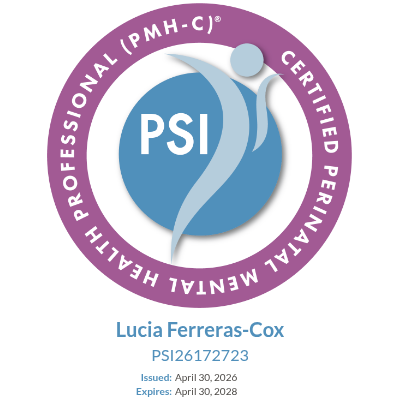
What PMH-C means for you: I don’t just listen. I screen, assess, and guide. I’m trained to recognize the early signs of perinatal mood and anxiety changes, to talk with you about them without judgment, and to connect you with specialized resources if you need more support than I can provide.
Meet Dr. Lucia: Three Specialties Under One Roof
Most new moms see one doctor for the baby and another for themselves, and nobody connects the dots. At Mind Milk MD, one clinician sees the whole picture, both of you.
- Board-Certified Pediatrician. 11 years of experience with newborns, babies, children, and teens, so I know what’s typical for your baby and what isn’t.
- Perinatal Mental Health-Certified (PMH-C). This is a specialty credential from Postpartum Support International for licensed health professionals who have completed focused training and passed an exam in pregnancy and postpartum mental health.
- International Board-Certified Lactation Consultant (IBCLC). Feeding struggles are one of the most common triggers for anxiety and tears in the early weeks, and I can help with both the feeding and the feelings.
- Certified in Healthcare Risk Management. Patient safety is built into how I practice.


Is This the Baby Blues, or Something More?
It helps to know the difference.
The baby blues affect many new moms in the first days after birth. You may feel weepy, moody, or overwhelmed, and it usually eases on its own within about two weeks.
Postpartum depression and anxiety last longer or get heavier over time. They can start during pregnancy or at any point in the first year after birth, and roughly 1 in 7 mothers experience them. Partners can experience them, too.
It may be time to reach out if you notice:
- Feeling sad, hopeless, numb, or empty most days
- Constant worry, racing thoughts, or a feeling that something terrible is about to happen
- Irritability or anger that feels out of proportion
- Trouble sleeping even when the baby is asleep, or sleeping far too much
- Little interest in things you usually enjoy
- Feeling detached from your baby, or guilty that you’re “not enough”
- Unwanted, scary thoughts that pop into your mind. These are common with anxiety and do not mean you want to hurt your baby, but please tell someone about them.
You don’t need to be sure it’s “bad enough.” If it’s affecting how you live, it’s worth a conversation.
How I Can Help
- Gentle, confidential screening and assessment using trusted screening tools, in a relaxed telehealth visit from your couch, your car, or your bed.
- Practical guidance you can use today, including sleep, feeding, routines, and asking for help.
- A bridge to specialized care when you need a therapist, a psychiatric provider, or a support group, and help figuring out the next step.
- Support for the whole family. Whether you’re the birthing parent or a partner, we’re here to help you through shifts in mood and identity.
- Care for your baby, too. Because I’m also a pediatrician, we can talk about your baby’s health, feeding, and development in the same visit.

Questions New Moms Ask About Their Babies and Bodies
These FAQs and answers are for general education and don’t replace a telehealth visit.
Why does my newborn cry for hours? Am I doing something wrong?
No. Crying peaks around 6 weeks of age, often in the evening, and then gradually improves by 3 to 4 months. When an otherwise healthy baby cries more than 3 hours a day, 3 or more days a week, for 3 or more weeks, it’s often called colic. It isn’t caused by bad parenting. Check the basics (hunger, diaper, gas, too much stimulation), and know that some crying has no fix.
If you feel yourself reaching your limit, place your baby safely on their back in the crib, step away for a few minutes, and call someone for help. Never shake a baby. A fever of 100.4°F (38°C) or higher in a baby under 3 months needs medical care right away.
Is my baby’s sleep normal? Why won’t they sleep longer?
Newborns sleep roughly 14 to 17 hours a day, but in short stretches, because their tummies are tiny and their sleep rhythms aren’t mature yet. Frequent waking is normal, and it’s not a sign you’re doing it wrong. Most babies aren’t ready for formal sleep training until about 4 to 6 months. For safety, always place your baby on their back, on a firm, flat sleep surface of their own, with nothing loose in the space.
If you can’t sleep even when your baby does, tell me. That can be a symptom worth treating.
Does my depression or anxiety affect my baby?
A parent’s stress and low mood can make everyday moments of connection harder, which is why it’s worth taking seriously. But babies are resilient, and getting support is one of the most protective things you can do for your child. This is a reason to get help early, not a reason for guilt.
I don’t feel bonded to my baby. Is something wrong with me?
Not necessarily. Many moms don’t feel an instant rush of love. Bonding grows over weeks and months through everyday moments like skin-to-skin contact, eye contact, singing, and feeding. If you feel numb, detached, or resentful for more than a couple of weeks, please tell me. It’s common, treatable, and nothing to be ashamed of.
How do I know my baby is developing normally?
Every baby grows at their own pace, but there are helpful signposts. Around 2 months, many babies begin to smile at you, look at your face, and calm when you talk or sing. Around 4 months, most hold their head steady without support and begin to chuckle or laugh. If your baby was born early, we use their adjusted age. If something feels off, trust your instincts and ask. Early check-ins make a real difference, and I can do a developmental check-in by telehealth.
Why is my baby so fussy at feedings?
Pulling away, arching, or crying during breast or bottle feeds can come from fast or slow flow, gas, reflux, positioning, tongue and mouth anatomy, or simple distraction. Feeding stress is also exhausting, and it can feed your own anxiety. As an IBCLC and a pediatrician, I can look at both sides. See our Lactation Support and Infant Nutrition pages.
My older child is acting out since the baby came. Is that normal?
Very. Tantrums, clinginess, potty accidents, and baby talk after a new sibling arrives are common, and they usually settle within weeks to a few months. Try 10 minutes of one-on-one “special time” each day, name the feeling out loud (“It’s hard to share Mommy”), give your child a small helper job, and keep routines predictable. If the behavior is intense, lasts, or affects school or friendships, our Behavioral and Developmental Care services are here for children ages 4 to 21.
Get Help Right Now
Mind Milk MD is a telehealth practice and is not for emergencies. Call 911 or go to your nearest ER if you have thoughts of harming yourself or your baby that you feel you might act on, if you’re seeing or hearing things that aren’t there, or if you feel confused or out of touch with reality.
- 988 Suicide & Crisis Lifeline: call or text 988, any time.
- National Maternal Mental Health Hotline: 1-833-852-6262 (1-833-TLC-MAMA), free and confidential, 24/7, in English and Spanish.
- Postpartum Support International HelpLine: 1-800-944-4773.
Take a deep breath.
Let’s fix this together.
Your mental health matters. Schedule a consultation and let’s talk about what you’re really going through.
